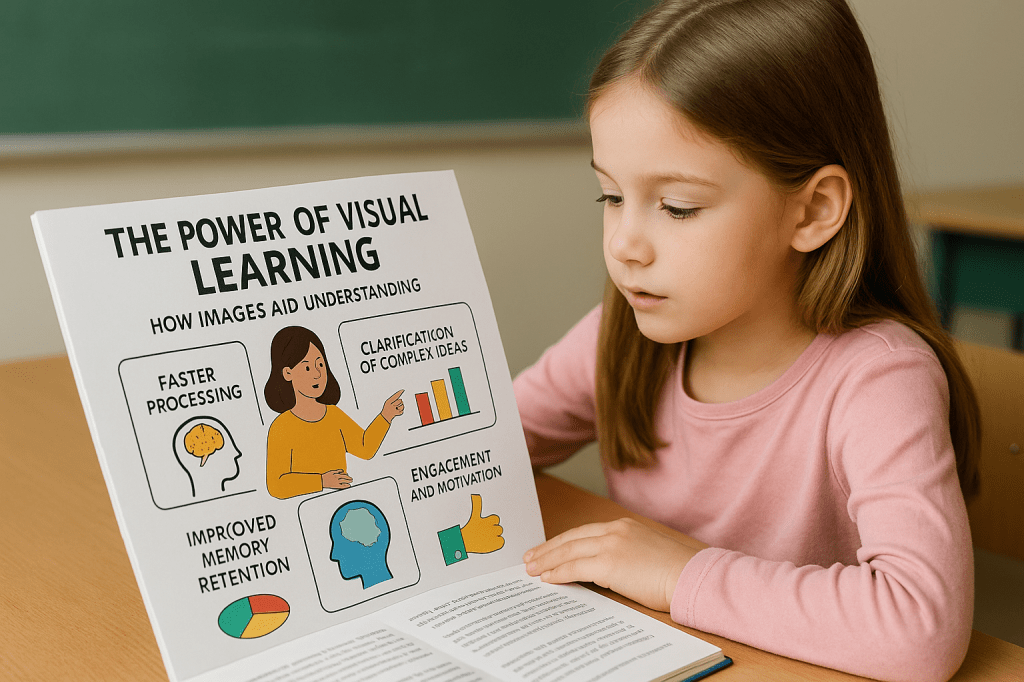
In our fast-paced, information-driven world, the ability to absorb and retain knowledge efficiently is more valuable than ever. Among the many strategies to support learning, visual learning has emerged as one of the most powerful. Whether we’re talking about preschool children identifying colors and animals, students navigating complex scientific diagrams, or adults trying to grasp abstract business concepts through infographics, the use of images plays a crucial role in enhancing understanding and memory.
But why exactly are visuals so effective? What makes them such a helpful aid in the learning process? And how can we use them strategically, especially when supporting children’s development? Let’s explore the power of visual learning and how images can transform the way we understand and engage with information.
—
1. What is Visual Learning?
Visual learning is a style of learning where individuals use images, diagrams, colors, charts, and other visual tools to understand and remember information. While everyone has different learning preferences, research shows that most people process visuals more quickly and effectively than text alone.
Visual learners often think in pictures and benefit from seeing material laid out graphically. Instead of reading long explanations, they understand better when they see a concept represented as a chart, a map, or an illustration.
For example, a child might grasp the idea of the water cycle more quickly by looking at a simple diagram showing rain, clouds, rivers, and evaporation, rather than reading a paragraph about it.
—
2. How Images Support Understanding
A. Faster Processing
The human brain processes visual information 60,000 times faster than text. Our eyes send signals to the brain almost instantly, allowing us to interpret pictures more quickly than written words. This speed is especially important in early childhood, when reading skills are still developing.
B. Improved Memory Retention
Studies have shown that people remember 80% of what they see and do, compared to just 20% of what they read. Visuals create a stronger imprint in memory, especially when connected with emotions or actions.
C. Clarification of Complex Ideas
Some topics are simply easier to understand with visuals. Think about a scientific concept like photosynthesis or a math problem involving fractions. A visual breakdown simplifies abstract concepts, making them easier to follow and apply.
D. Engagement and Motivation
Images grab attention. They make content more interesting and enjoyable, especially for young learners. A colorful book or infographic naturally invites interaction, curiosity, and deeper exploration.
—
3. The Role of Visuals in Early Childhood Education
Children are naturally visual learners. Long before they can read, they understand the world through what they see. This is why picture books, puzzles, toys, and interactive visuals are such essential tools in early education.
Picture Books:
Images help children follow the storyline, associate words with meanings, and develop language skills. For example, seeing a picture of a dog while hearing or reading the word “dog” helps the brain link the symbol with its real-world counterpart.
Visual Schedules:
In classrooms or at home, visual schedules using pictures can help children understand routines, transitions, and expectations. This is particularly helpful for children with special needs, such as autism or ADHD.
Educational Posters and Flashcards:
These tools provide quick visual references that reinforce vocabulary, numbers, emotions, or categories like animals or food. They’re easy to use during playtime, lessons, or daily routines.
—
4. Visual Learning Strategies for Parents and Educators
Supporting visual learning doesn’t mean every lesson needs to be turned into a picture book. However, incorporating a few key strategies can greatly enhance how children (and adults) understand and retain information:
A. Use Visual Aids Consistently
Whether it’s drawing diagrams, using labeled charts, or introducing illustrated flashcards, visual aids should be used consistently across subjects. The repetition helps build recognition and understanding.
B. Encourage Children to Draw
Drawing is a fantastic way for children to express what they know. Ask them to draw what they learned after reading a book or attending a class. This reinforces their comprehension and creativity.
C. Color Code Information
Colors are powerful memory triggers. For example, using red for verbs, blue for nouns, and green for adjectives can help children remember grammar rules more effectively.
D. Combine Visuals with Actions
Pairing images with physical activity (like hand gestures, moving objects, or building something) engages more senses, which increases learning potential.
E. Explore Visual Learning Apps and Tools
Today’s technology offers endless tools—from interactive story apps to educational games and digital drawing platforms. Used thoughtfully, these can provide extra visual stimulation and engagement.
—
5. Visual Learning and Children with Special Needs
Visual learning is particularly valuable for children with learning differences or special educational needs. For example:
Autism Spectrum Disorder (ASD):
Many autistic children benefit from visual instructions, schedules, and prompts, which provide structure and reduce anxiety in unpredictable environments.
Dyslexia:
Children with dyslexia may struggle with written text but can comprehend illustrated explanations more easily. Visual aids help bridge the gap between decoding letters and understanding meaning.
Attention Deficit Disorders (ADD/ADHD):
Images help maintain focus and attention. Visual cues can break up overwhelming tasks into manageable steps, which can support independence and confidence.
—
6. The Digital World and Visual Overload
While visuals are incredibly helpful, today’s digital world presents a challenge: visual overload. Children are constantly exposed to images, videos, ads, and flashing colors. Not all visual content supports learning.
To make the most of visual learning, it’s important to curate high-quality, educational images and avoid overstimulation. Choose materials with a clear focus, simple design, and purposeful use of visuals. The goal is to aid understanding, not distract from it.
—
7. Visual Learning Beyond the Classroom
Visual learning isn’t limited to academic subjects. It plays a role in emotional intelligence, social development, and even health and safety.
Emotion Charts help children identify feelings using illustrated faces.
Visual Recipes guide children step by step through cooking or daily tasks.
Road Signs and Symbols are part of visual literacy that supports independence.
Learning to “read” the world visually is just as important as reading words. In fact, visual literacy is now considered a key skill for the 21st century.
—
8. Final Thoughts: Why It Matters
Visual learning isn’t just a teaching method—it’s a bridge between understanding and expression. For children, especially in their formative years, images make the invisible visible. They turn abstract ideas into something they can see, touch, relate to, and remember.
As parents, educators, and creators, we have a unique opportunity to use visuals not just to decorate, but to empower. Whether you’re designing a picture book, creating a printable resource, or helping your child with homework, remember the power of a picture.
Sometimes, a single image can explain more than a thousand words ever could.








 Bright Minds Journey
Leave a comment